Cooling Gear

Air-Conditioned Clothing: Practical Cooling for Outdoor Work and Summer Use

Air-conditioned clothing uses compact fans to move outside air through a garment and around the wearer’s upper body. Its usefulness depends on fan placement, garment volume, airflow paths, battery position, and the type of work being performed.
By MotionWarm Product Development Team
Updated June 2026
5-minute read
worker wearing fan cooling workwear at industrial outdoor worksite
Fan-cooled work clothing should be evaluated in the movements, equipment conditions, and environments in which it will actually be used.
Direct answer

Air-conditioned clothing uses small electric fans to draw outside air into the garment and circulate it around the torso. It can improve comfort during selected outdoor and warm-weather activities, but performance depends on garment structure, fan position, airflow clearance, battery capacity, and environmental conditions.

How air-conditioned clothing works

The fans create a continuous air exchange between the outside environment and the space inside the garment. The system works best when the clothing leaves enough internal room for air to move from the fan inlets toward the upper body.

Fan Intake

Fan inlets must remain clear. A backpack, seat back, tool belt, or other equipment can reduce airflow if it covers the fan openings.

Internal Air Space

A garment that is too tight can restrict circulation. A garment that is excessively loose may allow air to escape before it reaches useful areas.

Airflow Path

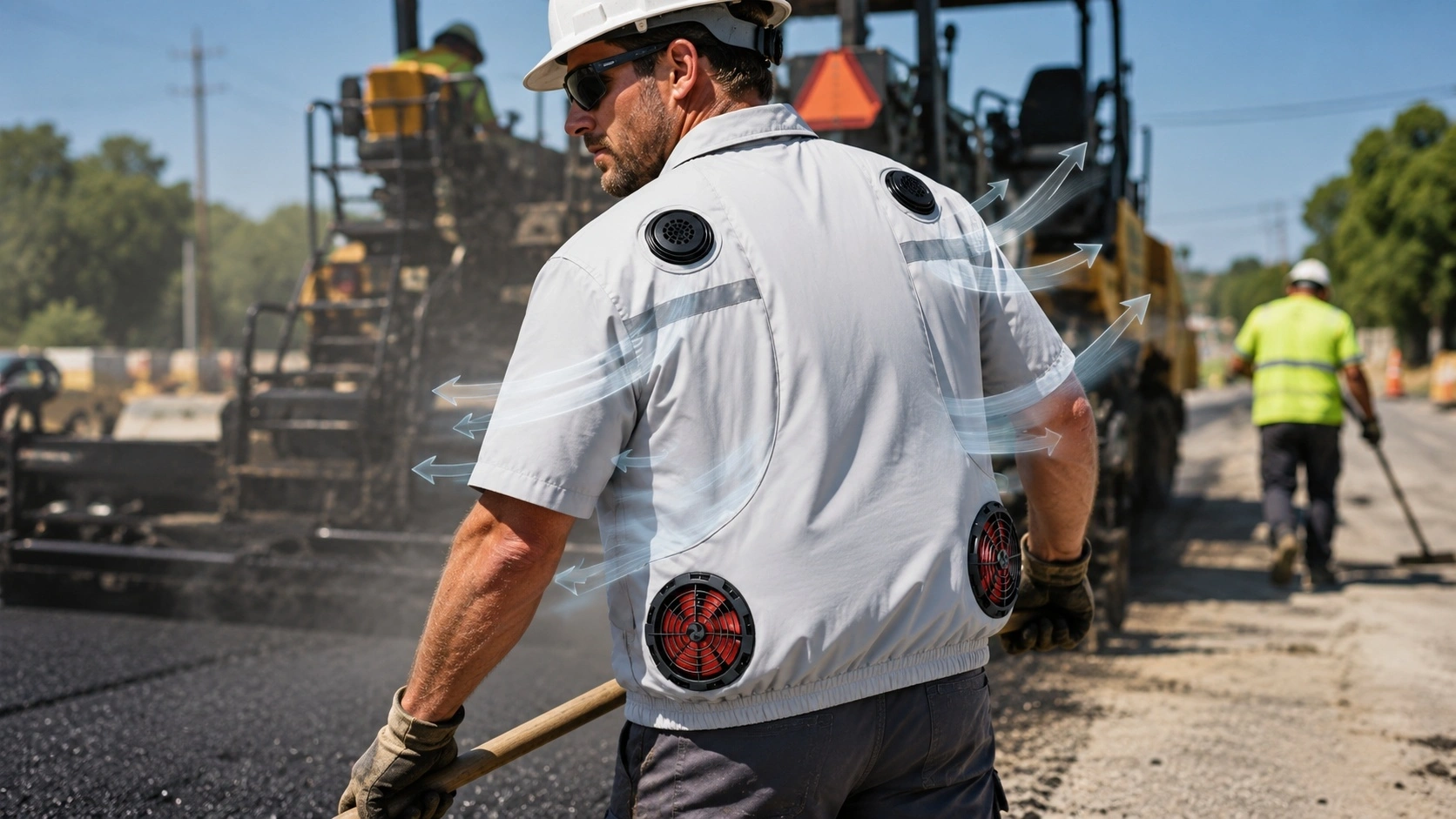
Air usually enters through the lower or rear sections of the garment, moves around the back and sides, and exits through the collar, arm openings, or other controlled gaps.

Power and Controls

Battery position, wiring, speed settings, connector protection, and removable components all affect daily use, cleaning, and maintenance.
The garment does not lower the surrounding air temperature. Its main function is to increase air movement inside the clothing and support evaporative cooling when environmental conditions allow.

OSHA notes that air movement is one factor that affects the body’s response to heat, while NIOSH describes occupational heat stress as a combination of environmental heat, metabolic heat, and clothing or personal protective equipment.

OSHA heat-stress guidance · NIOSH heat-stress overview
worker wearing white fan cooling shirt at construction worksite
Fan position, intake clearance, garment volume, and balance should be reviewed as one system rather than as separate components.

Where air-conditioned clothing is most useful

Fan-cooled garments are most practical in warm environments where the user can keep the fan inlets open and where moving air inside the clothing supports comfort during activity.

Construction and Outdoor Maintenance

These applications may benefit from additional airflow, but the garment must remain compatible with reflective safety layers, tool belts, harnesses, and other required equipment.

Warehouses and Logistics

Hot warehouses, loading areas, and logistics yards require testing during walking, lifting, driving, and seated work. Seat backs and vehicle use can affect fan clearance.

Landscaping and Agriculture

Outdoor maintenance and agricultural work may expose the fans to dust, grass, and debris, making inlet protection and cleaning access important.

Events, Travel, and General Summer Use

Lighter summer applications may place more importance on garment weight, noise, appearance, and portability than on workwear-level durability.

Use boundary

Fan-cooled clothing is a comfort aid, not a replacement for a workplace heat plan. OSHA recommends water, rest, shade or a cool rest area, acclimatization, training, and workload controls when heat is a hazard.

How buyers should evaluate air-conditioned clothing samples

Fan speed alone does not show whether the garment works well. Buyers should wear the sample and observe the full airflow path during standing, walking, lifting, sitting, and normal work movements.
Review Area
Garment Structure
Fan Position
Airflow
Power
Comfort
Materials
Production
What to Check
Fit, internal air space, hem control, arm openings, and collar exhaust
Intake clearance, balance, sitting comfort, and equipment compatibility
Whether air reaches the lower back, sides, upper torso, and exit points consistently
Battery position, connector type, controls, cable routing, and expected operating time
Weight, noise, vibration, pressure points, heat buildup, and freedom of movement
Breathability, durability, sweat contact, abrasion, and cleaning requirements
Fan mounting, removable parts, wiring protection, assembly consistency, and inspection points
Sitting tests are especially important because a chair, vehicle seat, or equipment surface may cover the lower fans or create pressure against the mounting rings. Buyers should also confirm that the fans, battery, and cables can be removed before garment washing.

The most useful sample is not necessarily the one with the largest fans. It is the one that creates a stable airflow path while remaining comfortable, wearable, and compatible with the user’s work.
Sample review should separate garment structure, fan performance, battery integration, materials, cleaning, and repeatable production.

Common questions

It increases air movement inside the garment and may support sweat evaporation and perceived comfort. It does not reduce the surrounding air temperature, and results vary with humidity, workload, garment fit, and environmental conditions.

Fans are commonly placed around the lower back or rear torso, where they can feed air into the garment. The final location should remain clear of seats, backpacks, belts, and required equipment while keeping the garment balanced.

Compatibility must be tested for each application. Reflective vests, fall-protection harnesses, tool belts, backpacks, and other PPE may block airflow, cover fans, or change how the garment fits.

Confirm the garment pattern, size range, fan model and location, battery, connectors, cable routing, control modes, materials, removable parts, washing method, packaging, instructions, and inspection requirements.

About MotionWarm

MotionWarm develops functional outdoor products for brands, importers, distributors, and product teams. Our cooling range includes air-conditioned clothing, wearable fan systems, and solar fan hats for different outdoor applications.

Explore Cooling Products · Discuss an OEM Project

error: Content on this website is protected.