How LED Pet Visibility Products Improve Night Walking Safety
Direct answer
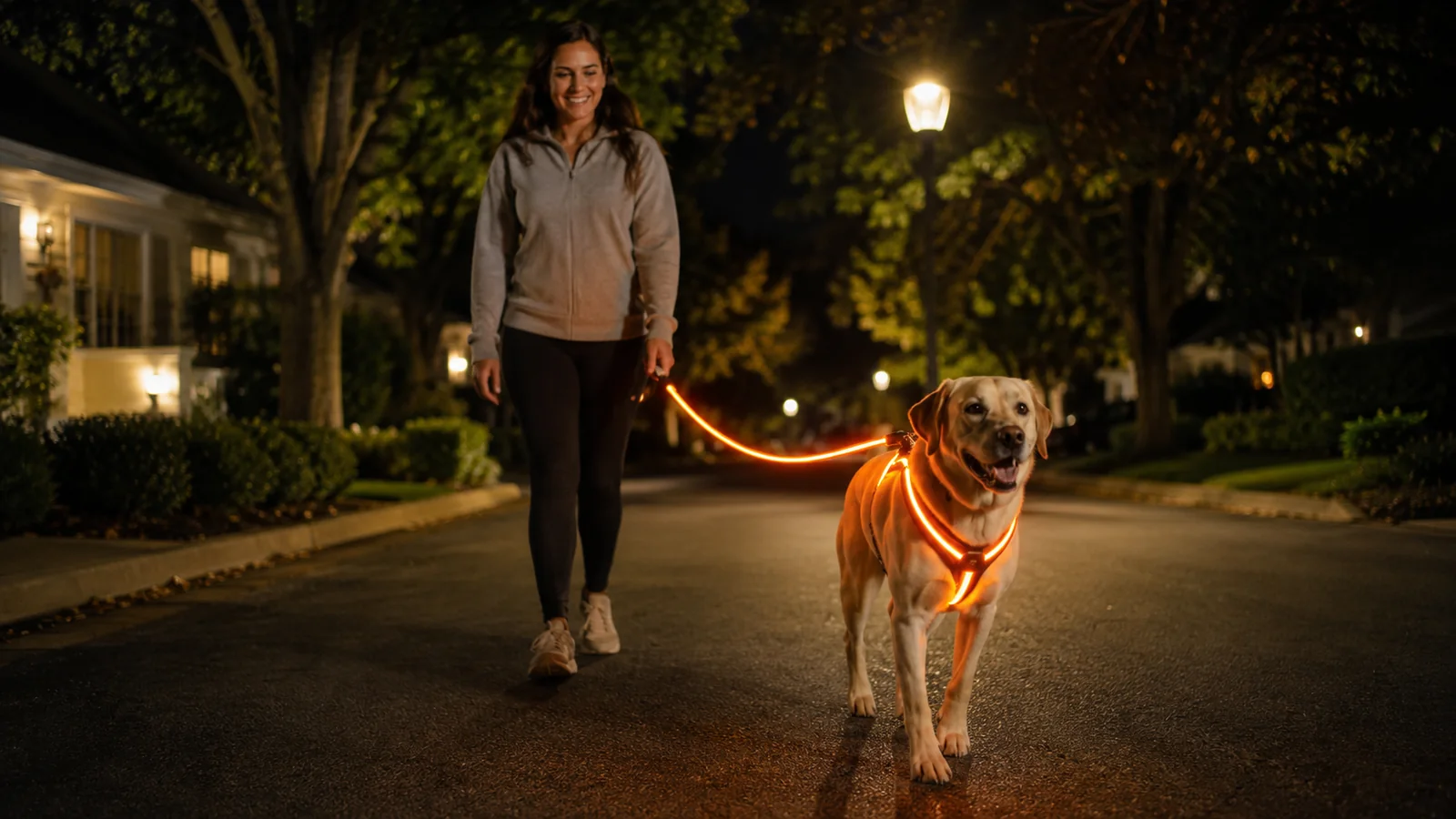
LED pet visibility products improve night walking by creating active points of light on the dog and, in the case of a lighted leash, along the connection to the handler. They are most effective when the illuminated areas match the real harness structure, remain visible from several angles, and do not interfere with fit, comfort, charging, or leash attachment.
Why visibility matters during night walks
The goal is not simply to make the product brighter. The goal is to make the dog’s location and direction easier to understand. A visible leash can add another useful reference by showing the space between the dog and the handler.
This follows a broader nighttime-visibility principle: reflective materials and active lights can help people become easier to notice in low-light environments. NHTSA also advises pedestrians to use reflective materials or a flashlight at night.
What makes an LED dog harness practical?
1. The light follows the real harness structure

2. Fit remains the first mechanical requirement
3. The leash attachment is structurally independent
4. Power and controls are easy to use
5. Lighting modes remain understandable
LED harness vs. lighted leash
What OEM buyers should evaluate
Common questions
No. Active lighting and reflective materials work differently. LEDs produce visible light, while reflective materials return light from another source. A product can use one or both depending on the application.
Not necessarily. Strategic light placement can communicate the dog’s position without adding unnecessary stiffness, wiring, weight, or cost.
It should be accessible to the user, protected from impact, and positioned so it does not create a pressure point on the dog.
Yes. Matching modes can create a coordinated product set, but the controls, power behavior, charging method, and user instructions should be tested together.
Request dimensions, adjustment range, material specifications, charging method, mode list, tested runtime, branding options, packaging details, and sample approval procedures.