Outdoor Applications

Solar Fan Hats for Outdoor Cooling: Use Cases and Product Considerations

Solar fan hats combine shade and localized airflow in one wearable product. Their usefulness depends on more than the number of fans. Hat coverage, fan position, weight balance, solar exposure, and the user’s activity all influence how the product performs outdoors.
By MotionWarm Product Development Team
Updated June 2026
6-minute read
angler wearing dual solar fan sun hat for lakeside fishing
A dual-fan outdoor hat combines shade, neck coverage, and localized airflow for selected outdoor activities.
Direct answer

A solar fan hat can be useful for fishing, gardening, walking, outdoor events, and light outdoor work where shade and localized airflow are helpful. Its performance depends on the hat structure, fan position, airflow direction, available sunlight, weight distribution, and how the product fits during movement.

Key takeaways
Shade coverage is as important as airflow.
Fan position should direct air toward the face without blocking vision.
Weight should remain balanced across the brim.
Solar performance changes with sunlight, shade, and panel angle.
Samples should be tested during real outdoor movement.

Where solar fan hats are most useful

Fishing

Fishing often involves long periods of sun exposure with limited access to shade. A wide brim, neck coverage, and balanced side fans can support comfort without interfering with normal head movement.

Gardening and Yard Work

Gardening involves frequent bending, turning, and looking downward. Fan mounts should remain stable, and the brim should not drop into the user’s field of view.

Walking, Travel, and Outdoor Events

For walking and travel, the product should remain lightweight and easy to carry. A rigid or oversized fan system may create more inconvenience than useful airflow.

Light Outdoor Work

A solar fan hat can support comfort during light outdoor tasks, but it should not be treated as a complete heat-safety system. OSHA notes that heat risk also depends on environmental conditions, physical activity, acclimatization, and clothing.

Hat shape, shade coverage, and wearing comfort

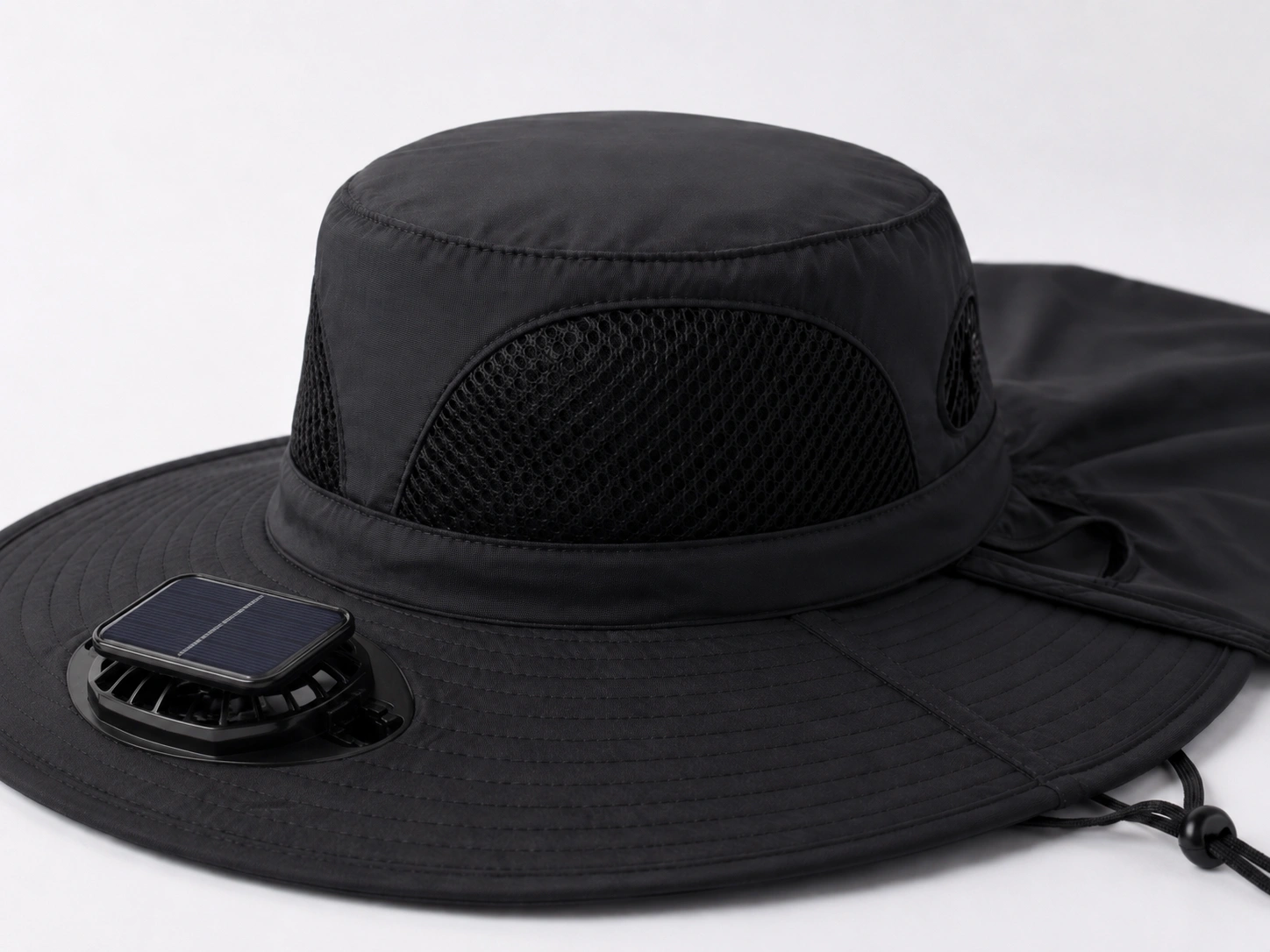
The hat structure determines how well the product works before the fans are even switched on. Brim width, crown ventilation, neck protection, and fit all affect comfort during extended outdoor use.

Brim Width

A wider brim can improve shade around the face, ears, and neck, but it also increases wind resistance and requires stronger shape support.

Neck Coverage

A rear neck flap can be useful during fishing, gardening, and other long outdoor activities. The fabric should remain lightweight and flexible enough to move naturally with the wearer.

Crown Ventilation

The crown still needs basic ventilation. Fans, solar panels, wiring, and structural support should not occupy every available surface or make the hat unnecessarily rigid.

Fit and Stability

Adjustable circumference, chin-strap stability, balanced fan placement, brim support, and comfort around the forehead and ears should all be reviewed together.

NIOSH guidance for outdoor workers also emphasizes protection for exposed areas such as the ears, scalp, and neck, which supports the value of adequate brim and neck coverage during extended outdoor use. NIOSH sun-exposure guidance
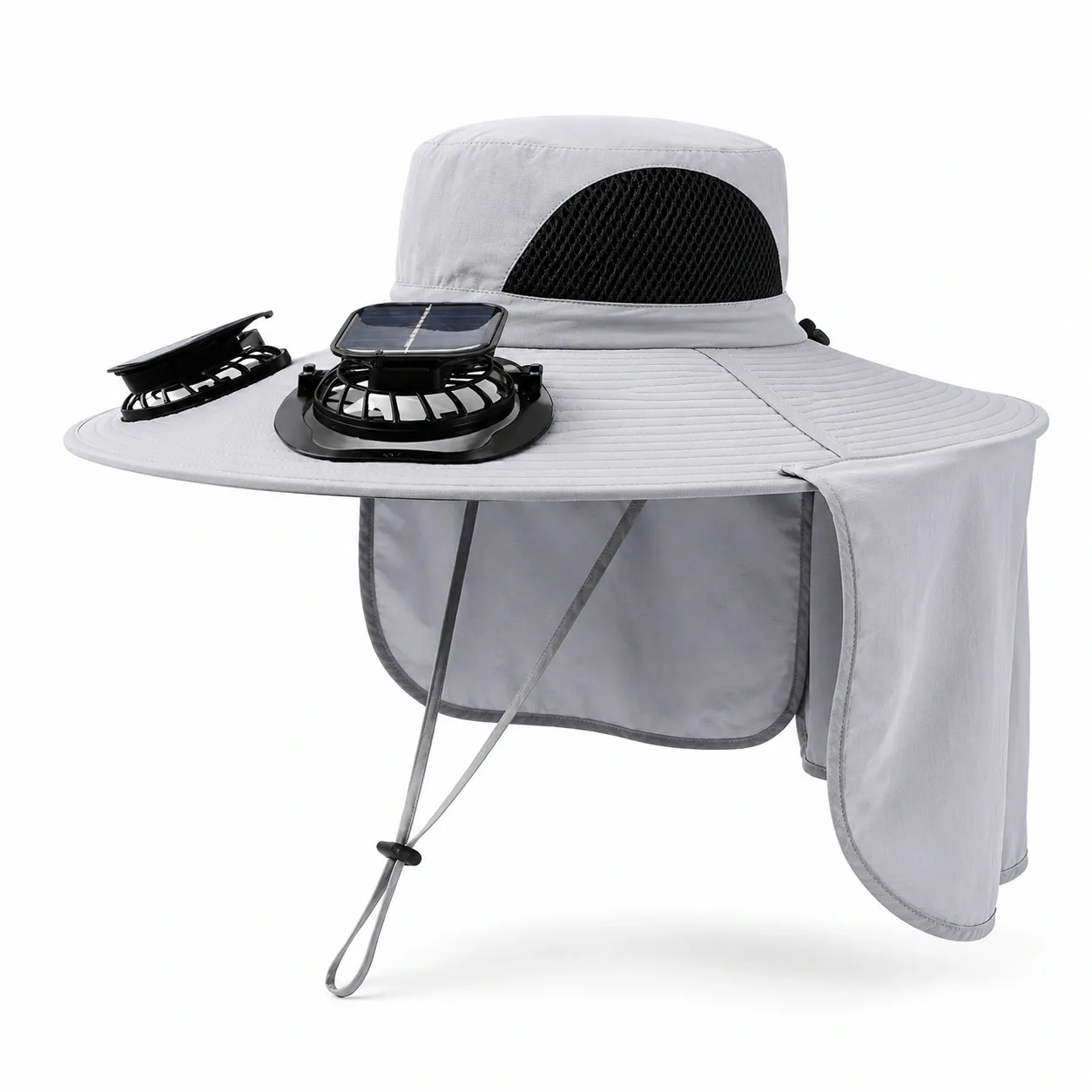
gray dual solar fan sun hat product display with neck shade
Product structure should remain wearable and balanced while keeping the brim, fans, solar panel, and neck flap clearly integrated.

Fan placement, airflow, and solar power

Fan Placement

Two fans should sit in balanced positions on the left and right sides of the brim. They should direct air toward the face or temple area without entering the user’s normal field of view.

Airflow Direction

Fan angle is often more important than fan size alone. A larger fan does not guarantee useful airflow if it points away from the user or causes the brim to tilt.

Solar Exposure

Solar output should not be treated as constant. Direct sunlight, cloud cover, partial shade, panel angle, and movement can all affect fan speed. The U.S. Department of Energy explains that photovoltaic performance depends on the sunlight available to the solar cell and the wider system design. U.S. Department of Energy photovoltaic guidance

Noise and Vibration

Because the fans sit close to the ears, noise and vibration should be included in sample testing. The highest speed is not always the most comfortable setting for extended use.

Useful airflow

The fan should send air toward the wearer rather than simply spinning at a high speed.

Balanced construction

The fan should send air toward the wearer rather than simply spinning at a high speed.
Compact fan mounting, panel position, wiring, and material support should be reviewed as one integrated structure.

How buyers should compare solar fan hat samples

Solar fan hat samples should be tested outdoors rather than judged only by whether the fans rotate indoors. Different head sizes, walking movements, wind conditions, and light angles can reveal problems that are not visible on a workbench.
Review Area
Hat Structure
Fan Position
Comfort
Solar Performance
Materials
Production
What to Check
Brim shape, crown support, neck coverage, and packability
Air direction, balance, visibility, and clearance from the face
Weight, pressure points, noise, vibration, and chin-strap stability
Response under direct sun, partial shade, and changing panel angles
Sun exposure, sweat contact, stitching, and cleaning
Fan mounting, wiring, panel attachment, and repeatable assembly
The most useful sample is not necessarily the one with the largest fans. It is the one that keeps the hat wearable while providing stable shade and practical airflow.

Common questions

Direct-solar performance normally decreases in shade or weak light. The actual response depends on the solar panel, electrical design, and whether the product includes battery support.

Two fans can provide more balanced airflow on both sides of the face, but they also add weight, wiring, and structural requirements. Position and balance are more important than fan count alone.

A wide-brim hat with neck coverage can be useful during long periods of sun exposure. The final choice should also consider weight, packability, wind resistance, and the user’s activity.

Buyers should confirm the hat shape, size range, fan position, solar panel layout, wiring, controls, materials, colors, packaging, instructions, and inspection requirements.

About MotionWarm

MotionWarm develops functional outdoor products for brands, importers, distributors, and product teams. Our cooling range includes solar fan hats and wearable fan systems for different outdoor applications.

Explore Cooling Products · Discuss an OEM Project

error: Content on this website is protected.